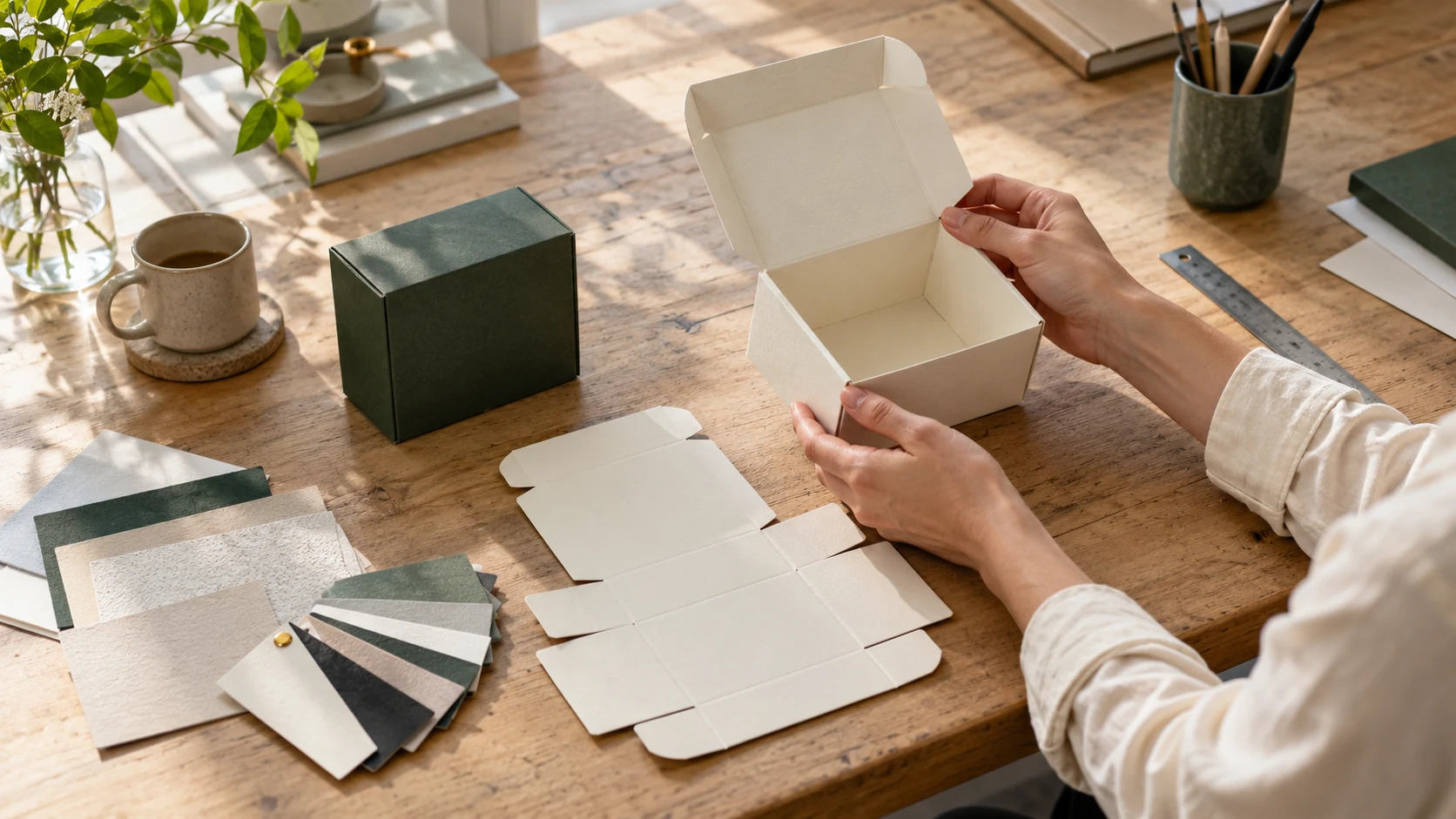
Before approving custom packaging, check five things together: the product fits, the material suits its journey, the artwork follows the final dieline, the sample represents what you are approving, and the delivery specification is clear. A polished mockup cannot answer all five.
For a Dubai product launch, exhibition giveaway or retail release, an error can affect every unit in the run. A gift box that will not hold the final bottle, a sleeve that covers essential product information or an unreadable QR code can turn a finished design into urgent rework.
This checklist explains what to check at each approval stage, and what to ask your packaging supplier before production begins.
Start with the packed product and its journey
Give the supplier a physical product where possible. Otherwise, provide verified dimensions and weight, including caps, handles, accessories and protective wrapping. Clarify whether measurements describe the product, the usable space inside the pack or the finished outer box.
List what must fit inside. A launch kit might include a product, an insert, a printed card and a cable. Adding the card after the box is sized can change the fit or hide the first thing the recipient should see.
Then describe the journey:
- Will the pack sit on a retail shelf, travel by courier or be handed directly to a guest?
- Will it be packed in advance, stored, transported to a venue and unpacked again?
- Does it need to stack, fit a carrier bag or sit inside a protective shipping carton?
- Will heat, moisture, refrigeration or repeated handling affect it?
For event gifting, work back from the venue delivery slot. Include time for assembling, filling and checking the packs, rather than treating the print completion date as the event-ready date.
Choose the structure before the decoration
Start with the job the packaging must do. A folding carton can be suitable for a compact retail product. Corrugated packaging may be appropriate when transport protection matters. A rigid presentation box can suit a gift set, but its outer shipping protection still needs a separate decision. A sleeve adds branding around an existing pack; it does not automatically provide protection or hold the contents securely.
These are starting points, not material specifications. Ask the supplier to recommend the board, thickness, construction and closure for your actual product. A heavier board or more expensive finish does not, by itself, prove that the pack will work better.
For inserts, check both retention and removal. The product should stay in place during the intended handling, while a recipient can lift it out without tearing the packaging or damaging the item.
If food contact, specialist product labelling or environmental claims are involved, confirm the applicable requirements with the responsible product or compliance specialist. Request evidence for the proposed material and intended use. Appearance alone cannot establish suitability or recyclability.
Read the dieline as a map of the finished pack
A dieline is the technical layout showing how the flat material will be cut, folded and assembled. Artwork needs to follow the approved version, including the orientation of each panel.
Ask the designer to walk through the assembled pack with you. Identify the front, back, lid, base, inside surfaces and glue areas. Check what is visible when the pack is closed and what appears first when it opens. Small panel-orientation errors can leave a logo upside down after assembly.
Confirm these details before final artwork approval:
- The drawing is at the agreed scale and matches the approved dimensions
- Cut lines, fold lines and technical annotations are clearly separated from print artwork
- Logos, text and codes are safely positioned away from cuts, folds and glue areas
- Background artwork extends into the required bleed area
- Foil, embossing or other finish areas follow the printer's file requirements
Bleed is extra artwork beyond the final cut edge. Its purpose is to avoid an unprinted sliver when trimming varies slightly. Adobe's bleed guidance explains the principle, but the supplier should confirm the exact allowance for your packaging. Do not copy a setting from an unrelated print job.
Check content at its final printed size
Review the production artwork at actual size, not only enlarged on a screen. Read the smallest text, inspect fine lines and check that the logo remains legible on the chosen background.
For English and Arabic packaging, have each language reviewed by a fluent reviewer. Check the wording as well as the direction and layout. Mixed-language product names, numbers and contact details deserve particular attention. A correct translation can still be difficult to read when it is placed on a narrow folded panel.
Separate content approval from design preference. One named reviewer should confirm the approved product name, variant, quantity, contact details and any required product information. Another person can check visual consistency if needed, but feedback should return as one consolidated revision.
Test QR codes on a representative printed sample at final size. Check that the destination is correct and mobile-friendly, and that the code still scans after assembly. For retail barcodes, ask for appropriate barcode verification; a successful phone scan alone is not a full print-quality check.
Know exactly what your sample proves
Different samples answer different questions. Ask what is representative and what is provisional.
- A plain structural sample helps assess dimensions, folding, closure and product fit
- A colour proof helps review artwork and colour within the limits of the proofing method
- A finished production-representative sample helps assess the proposed combination of stock, print and finish
A prototype made with a substitute board or without the final finish cannot fully demonstrate the finished result. Record those differences before approving it.
Place the real contents inside and assemble the pack as the fulfilment team will. Check the opening sequence, insert fit, closure, scuffing and handling. For labels, test on the actual container under the intended conditions. Ask the supplier what additional checks are appropriate to the product and delivery journey.
Colour also needs a clear reference. Screens, proofing systems, paper stocks and finishes can show colour differently. Agree how critical brand colours will be assessed and which approved reference the production team will use.
Compare quotes against the same specification
Two quotations are comparable only when they cover the same pack. Send both suppliers the same dimensions, quantity, artwork requirements, material and finish specification, sample requirement and delivery destination.
Ask whether the price includes tooling, printing, finishing, inserts, assembly, packing and delivery. Separate initial setup costs from the unit cost where relevant, and ask what would change on a repeat order. A lower unit price can be misleading if the box arrives flat and assembly was not budgeted.
For mixed gift sets, corporate gift packaging should be specified alongside the actual items. Confirm who receives the products, checks their quantities, fills the boxes and replaces damaged components.
Sign off one final production specification
Keep a short approval record that names the final artwork file and version, approved dieline, quantity by variant, material, finish, sample reference and delivery instructions. Confirm which differences, if any, remain between the approved sample and the production run.
Before releasing production, make sure these questions have clear answers:
- Has the final product been tested inside the pack?
- Have both content and print preparation been approved?
- Are the finish, colour reference and acceptance criteria recorded?
- Who is responsible for assembly and final packing?
- Are the delivery date, location and receiving contact confirmed?
Adobe's print-ready PDF guidance is useful for the artwork handoff. The printer's required PDF preset, colour profile and production settings should govern the final export.
Frequently asked questions
Can packaging artwork be designed before the dieline is final
Early visual concepts can be developed first, but production artwork should use the approved dieline. Changes to dimensions, folds or closures can affect panel proportions and artwork placement.
Is a digital mockup enough to approve a packaging order
A mockup helps you judge appearance. It does not establish physical fit, material behaviour, assembly or the final print and finish. Agree an appropriate sample for the production decisions you need to make.
What should I send for a custom packaging quote in Dubai
Send the product dimensions and weight, intended use, quantity by variant, brand assets, required content, preferred materials or reference packs, and delivery deadline. State whether you need design, prototyping, printing, assembly or a combination.
Can the same box work for an event gift and courier delivery
Possibly, but it must be assessed for both journeys. A presentation box may require an additional outer carton and protection for courier handling. Confirm this before fixing the overall dimensions and budget.
Plan your packaging with a clear brief
Naqsh Media provides packaging design and printing in Dubai, including dieline development and physical prototyping. Share your product details, quantity and required delivery date to discuss the right specification before approving the print run.